June 10 2026
More than art
At Calvary Mater Newcastle’s Mercy Hospice, something special is happening through the Fig Tree Day Hospice Program. It’s not clinical or structured in the usual sense, it’s simply about people and their stories.
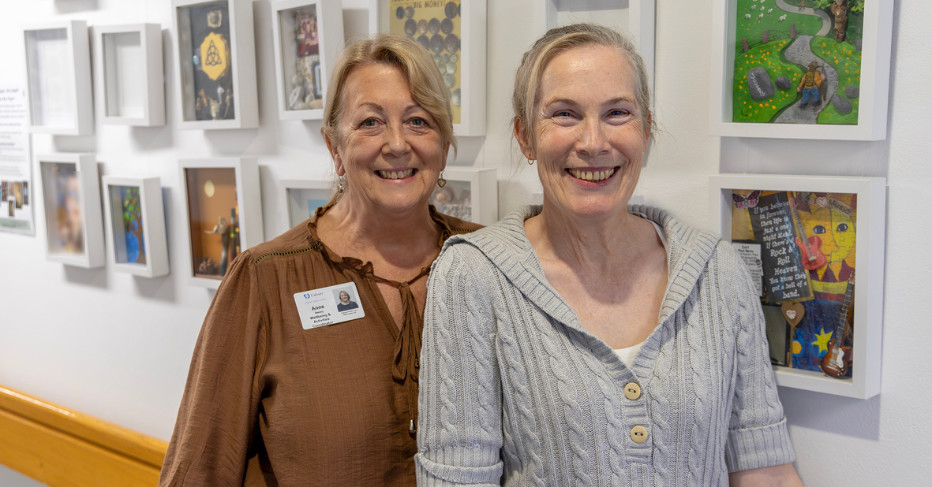
Through an Arts Health installation project kindly funded by Dry July and its supporters, patients living with advanced cancer and other life-limiting illnesses, along with their families, are given the chance to create, reflect and share what matters most to them.
For many, it becomes a way to tell their story and leave something behind. At its core, this project is about storytelling.
In the Fig Tree Program, art has a way of gently opening people up. It might start with something simple but it often grows into something much deeper.
People begin talking about where they’ve been, what they love, what’s important to them. Conversations about life, but also about death and dying, come more naturally in a space that feels safe and supportive.
The Memory Box Project is led by Jo Haney, Occupational Therapist and Day Hospice Co-Coordinator, and Anne Henry, Wellbeing and Activities Coordinator, with support from the broader palliative care team. Together, they’ve created an environment where people feel comfortable enough to give it a go, even if they don’t think of themselves as creative.
“Some people come in saying they’re not creative at all,” Jo says. “However, once they start, something shifts. By the end, they’re often surprised or proud of what they’ve done.”
Participants are encouraged to create artwork that can be displayed in a shadow box art frame. The artwork can reflect something personal - memories of travel, family, interests, identity.
The artworks now line the corridors of the Hospice, bringing warmth to the space and creating natural points for patients and visitors to admire and take-in the story of a person’s life.
The display continues to grow over time, shaped by each person who takes part. No two pieces are the same. When the time comes, families and loved ones can take these artworks home, carrying with them something deeply personal. In this way, the installation is always evolving, reflecting each patient’s journey and the stories they choose to share.
During the process of art creation, people start to notice each other’s work, and through that, they may begin to understand each other a little more – what they’ve been through, what matters to them.
“Things come out in these sessions that might not otherwise,” Anne says. “It builds a real sense of connection between people.”
For many patients, the creative process also offers a break from the reality of illness. Even for a short time, the focus shifts away from appointments and symptoms to making something meaningful.
“It takes their mind off the everyday and often what they create becomes really special for their family,” Anne explains.
The idea of leaving something behind, a legacy, is a big part of the project. Whether it’s through images, words or materials, each artwork becomes a reflection of a life.
Jo says, “We’re incredibly grateful to Dry July and its supporters for helping fund this arts health project. It allows us to go beyond the clinical side of care and create something really meaningful for our patients. It gives patients the chance to tell their stories at such an important time in their lives. That opportunity means a lot, not just to patients, but to staff as well, being able to offer something like this.”
She adds, “The Fig Tree Program continues to grow thanks to the support of Dry July, and there’s a real sense of gratitude for being able to keep offering experiences like this. At the end of the day, it’s not just about the art, it’s about people, their stories, and the moments they choose to share.”