June 29 2026
Calvary Mater Newcastle advancing bowel cancer research and early detection
A novel blood test for the earlier diagnosis of bowel cancer is just one of the new approaches the Calvary Mater Newcastle’s Bowel Cancer Research Program is investigating in its efforts to lead advances in early detection, treatment and survivorship care.
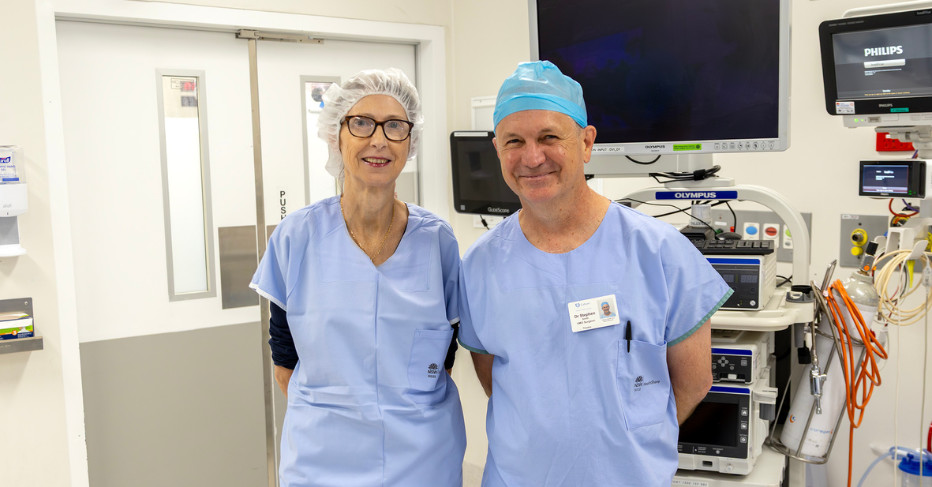
Calvary Mater Newcastle Colorectal Surgeon and Bowel Cancer Research Program Lead, Professor Stephen Smith, said the program focused on addressing critical gaps in bowel cancer care.
“Our program directly addresses these gaps by improving early detection, enhancing surgical outcomes and supporting prevention, particularly for people at high risk or with limited access to specialised care,” Professor Smith said.
One of the key aims of the research program is to improve the early diagnosis of bowel cancer and precancerous polyps.
“It is hoped that, once validated, these new testing methods will reduce the proportion of bowel cancers diagnosed at a late stage, improving survival outcomes and reducing the burden of treatment through surgery,” Professor Smith said.
“It is also hoped this low-cost, scalable diagnostic platform can be adopted across Australia, including in disadvantaged and hard-to-reach communities.”
Bowel cancer survivor Teanna Blanch was 32-years-old and diagnosed with Stage 2A bowel cancer while 25-weeks pregnant with her second daughter.
Teanna said the diagnosis came as a complete shock.
“At 25-weeks pregnant, I woke from a colonoscopy to the dreaded words, ‘I am so sorry, you have cancer’,” Teanna said.
“They are words no one wants to hear, and words no doctor wants to say to a 32-year-old pregnant woman - or to anyone, for that matter. Cancer was something I never imagined would happen to me. I was fit, healthy and young. At that age, you think you’re invincible.”
Professor Smith treated Ms Blanch in close consultation with her obstetrician. The surgery was successfully performed at 28-weeks’ gestation, removing all of the cancer. Her baby was later delivered at 36-weeks’ gestation.
Teanna is passionate about raising awareness of early detection and supporting advances in treatment.
“I am incredibly proud to be part of this bigger picture,” she said.
“Sharing my story, creating awareness around early detection and helping advance treatment options has become a real passion of mine. Hand on heart, all I want to do is help save lives and create a future where our community, friends, families and children have a fighting chance against this disease.
“Early detection makes all the difference to outcomes. We are so fortunate to have Professor Smith and his team - compassionate, driven people who genuinely want to save lives and make a difference.”
The Calvary Mater Newcastle Bowel Cancer Research Program has evolved since its first clinical trial in 2005, led by two colorectal surgeons and one research nurse.
A core strength of the program is its focus on randomised controlled trials and high-quality clinical research that directly informs and changes clinical practice, ensuring the research delivers improved patient outcomes.
Bowel cancer is the fourth most commonly diagnosed cancer and the second leading cause of cancer-related death in Australia.
However, when detected at an early stage, more than 99 per cent of cases can be treated successfully.
Calvary Mater Newcastle is the main referral hospital for the region’s bowel cancer patients, underscoring the importance of locally-driven research and accessible services to support early detection, timely treatment and ongoing surveillance of patients across the community.
If you would like to support this important cause, you can make a donation here.
Images: Jess Newell Photography


1 / 0