About head and neck cancer
Head and neck cancers do not attract a lot of publicity. The general population is largely unaware of the causes, symptoms, treatments and consequences of head and neck cancer until they or someone they know is diagnosed with one of these cancers.
According to Cancer Council statistics, approximately 4,000 Australian people (2,920 men and 1,080 women) are diagnosed with a head and neck cancer each year. While worldwide, head and neck cancer is the sixth most frequently occurring cancer. Men are two to three times more likely to develop this type of cancer than women. However the incidence of head and neck cancer in women is now increasing.
Head and neck cancer is most common in people over the age of 40, but there has been a recent increase in younger people developing the disease.
Head and neck cancer, and the treatments used to combat it (surgery, radiotherapy and chemotherapy), may have a significant impact on a person’s appearance, ability to eat and/or communicate both short and long term.
What is head and neck cancer?
Head and neck cancer is a general term that refers to a range of different cancers that start developing in the head and neck region of the body. This includes the oral cavity, tongue, palate, jaw, salivary glands, throat (larynx) and the nose.
Most head and neck cancers start in the squamous cells that line the mouth, nose or throat. These are called Squamous Cell Carcinomas (SCCs).

Types of head and neck cancer
All diagrams are courtesy of cancercouncil.com.au.
Mouth or oral cancer refers to cancers that start anywhere in the mouth (lips, inside cheeks, front two thirds of tongue, floor of mouth, jaw and gums).
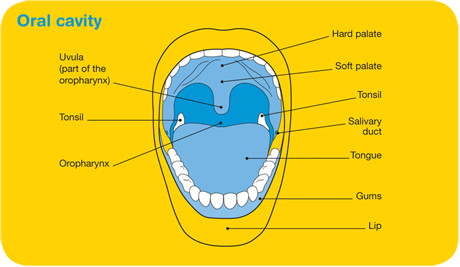
Pharyngeal cancer refers to cancer that begins in the throat (pharynx). The pharynx runs from the back of the nose to the gullet (or oesophagus) and the windpipe (or trachea).
The pharynx is divided into three sections:
- Nasopharynx= cavity behind the nose and above the soft palate.
- Oropharynx= area from the soft palate and tongue base to the back of the mouth including the tonsils.
- Hypopharynx= the lowest part of the throat behind the voice box or larynx.
Air passes through the nasopharynx as you breathe in and out.
Both food and air pass through the oropharynx and hypopharynx. Food goes into the stomach via the oesophagus, while air goes into the trachea to get to the lungs.
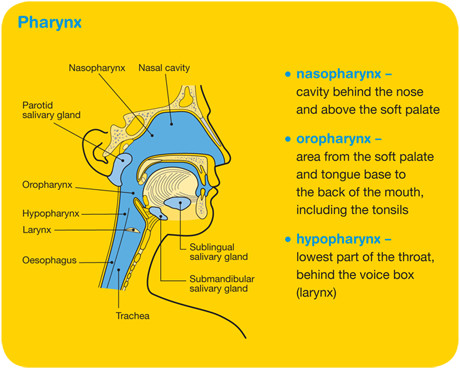
Cancers will be classified as nasopharyngeal, oropharyngeal or hypopharyngeal depending on where in the pharynx they develop.
Laryngeal cancer refers to cancers that start in the voice box (larynx). The larynx is the short passageway that connects the lower part of the pharynx (hypopharynx) with the wind pipe (trachea). It contains the vocal cords (glottis) which vibrate when air passes through them to produce sound.
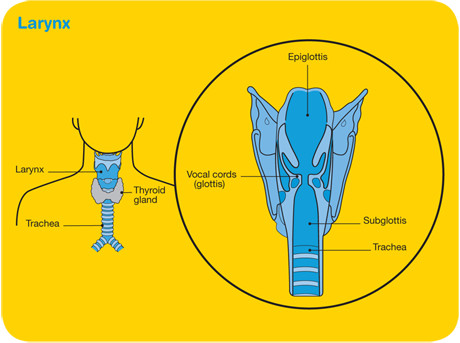
Above the vocal cords is the epiglottis which prevents food from going into the trachea when you swallow. Below the vocal cords is the subglottis. Under the larynx, in front of the trachea is the thyroid gland.
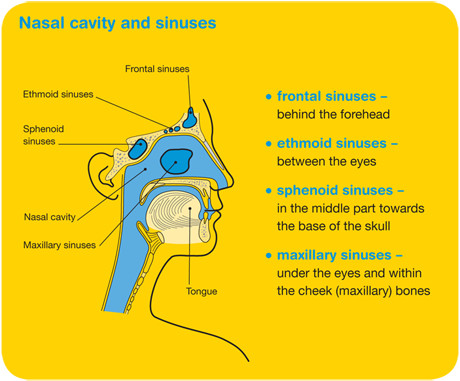
Nasal cancer or Para nasal sinus cancer includes cancer starting in the nose, nasal cavity or the sinuses.
What are the risk factors for head and neck cancer?
A risk factor is any factor that is associated with increasing someone’s chances of developing a certain condition, such as cancer.
Some risk factors are modifiable, such as lifestyle or environmental risk factors, and others cannot be changed, such as genetic or inherited factors.
Having one or more risk factors does not mean that you will develop cancer. Many people have at least one risk factor but will never develop cancer, while others with cancer may have had no known risk factors. Even if a person with cancer has a risk factor, it is usually hard to know how much that risk factor contributed to the development of their disease.
The main factors that are associated with a higher risk of developing head and neck cancer are:
Smoking and alcohol
Smoking and alcohol consumption are the main risk factors for most types of head and neck cancers, except for salivary gland cancer. Research indicates that at least 75% of head and neck cancers are caused by a combination of cigarette smoking and alcohol consumption.
Smoking cigarettes, cigars or pipes is associated with an increased risk of head and neck cancer, especially of the larynx.
Alcohol use may lead to an increased risk especially in heavy drinkers (three or more drinks per day). Smoking and using alcohol greatly increases your risk.
HPV
Infection with some types of human papillomavirus (HPV), especially for cancers involving the tonsils, the base of the tongue, the paranasal sinuses and the nasal cavity.
Infection with Epstein–Barr virus
Infection with Epstein–Barr virus (the virus that causes glandular fever), for nasopharyngeal cancer and salivary gland cancer.
Signs and symptoms of head and neck cancer
The “One for Three” definition, developed by leading experts in head and neck cancer across Europe, states that GPs should refer a patient to a head and neck cancer specialist if they have any one of the above symptoms for more than three weeks.
Diagram courtesy of: makesensecampaign.eu/cancer-information.
Stages of head and neck cancer
If you are diagnosed with head and neck cancer, you might have more tests to determine the stage of the disease and whether the cancer has spread to other parts of the body. Knowing the stage of the disease helps your medical team plan the best treatment for you.
One of the main techniques used to assess this is the TNM staging where T stands for tumour and is based on its size, N stands for local lymph node involvement and M stands for metastasis which is when the cancer spreads to other parts of the body.
Treatments
The treatment used for your head and neck cancer will depend on the site where it has developed, the type of cancer it is and the stage at which it is diagnosed.
Surgery, radiotherapy and chemotherapy either on their own or in various combinations are commonly used to treat head and neck cancers.
Skin cancers of the head and neck region
Skin cancers of the head and neck region are common and Australia has one of the highest rates of skin cancer in the world.
The majority of skin cancers of the head and neck area are non-melanoma skin cancers (NMSC). Basal cell and squamous cell carcinomas are the most common types of NMSC.
Sun safety and early evaluation of suspicious areas remain the first line of defence against skin cancers. It is important to be aware of your skin and learn what is normal for you.
Watch out for:
- Spots that are new or different from other spots on your skin
- A sore that does not heal
- A spot that bleeds
- A spot, mole, freckle that has changed in size, shape or colour.
If you notice anything new or different ensure your GP or dermatologist check it. Skin cancers that are found and treated early need less invasive treatment and have a better outcome.
Depending on the extent of the disease at diagnosis, treatments for skin cancer may include surgery, radiotherapy, chemotherapy or various combinations of these.